


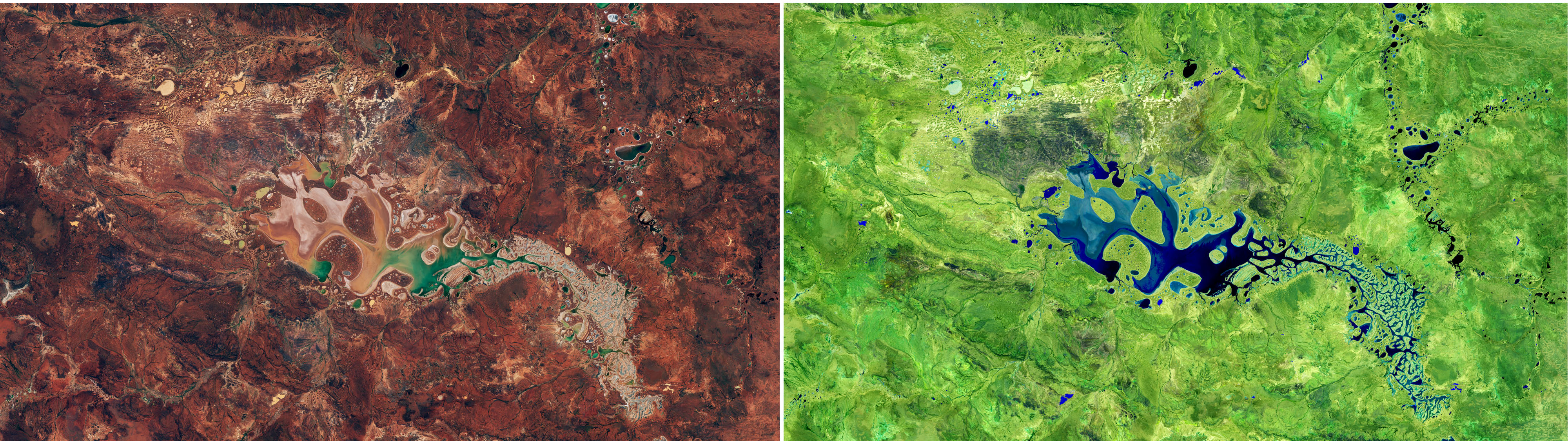
Per festeggiare Halloween, vi presentiamo questi panorami spettrali del Lago Carnegie in Australia, catturati dallo spazio grazie a Copernicus Sentinel-2.
Il lago Carnegie si trova al confine sud-occidentale del deserto di Gibson nella Contea di Wiluna nell'Australia occidentale, a circa 900 km a nord-est di Perth, la capitale dello stato.
Essendo un grande lago effimero il Carnegie si riempie d'acqua solo dopo forti piogge, che di solito sono rare nella regione. Quando è pieno la sua superficie totale è di circa 5700 kmq, il che lo rende uno dei laghi più grandi dell'Australia. Nei periodi di siccità si restringe fino a diventare una palude fangosa. Queste immagini sono state catturate dopo piogge insolitamente intense nell'Australia occidentale, rendendo la ‘faccia’ spettrale del lago facilmente visibile dallo spazio.
Le connotazioni spettrali non finiscono qui, poiché il lago Carnegie è stato osservato attraverso diverse bande spettrali dal sensore per immagini multispettrale di Copernicus Sentinel-2. L'immagine a sinistra mostra il lago con colori naturali, così come lo vedrebbe l'occhio umano, mentre l'immagine in falsi colori a destra è stata elaborata utilizzando tre bande spettrali specifiche per creare l'effetto di un aspetto sinistro.
Questa combinazione di bande fa risaltare l'acqua con un blu intenso, il che rende i contorni del lago più distinti e la scelta può essere utilizzata per individuare i modelli di inondazione dell'area. In particolare, alla sua estremità sud-orientale il lago lascia il posto a paludi e canali, che possono essere distinti più chiaramente nei falsi colori piuttostochè nell'immagine a colori naturali.
Mentre solo una dozzina di persone risulta che vivano intorno al lago Carnegie, il lago fornisce un importante habitat e aree di riproduzione per grandi stormi di uccelli. Si ritiene inoltre che sia la patria dell'elusivo pappagallo notturno, che è in pericolo di estinzione e che si pensava fosse estinto da 100 anni.
L'intera area fa parte del Parco Nazionale Matuwa Kurrara Kurrara e della riserva naturale del Lago Carnegie, che ha lo scopo di proteggere l'importante biodiversità dell'area ed il patrimonio culturale aborigeno.
Scarica immagine1 HiRes (1,14 MB - .JPG)
Scarica immagine1 HiRes (68,10 MB - .TIF)
Scarica immagine2 HiRes (1,19 MB - .JPG)
Scarica immagine2 HiRes 66,73 MB - .TIF)
---
Ghostly lake
To celebrate Halloween, we bring you these spooky sights of Lake Carnegie in Australia, captured from space by Copernicus Sentinel-2.
Lake Carnegie lies at the southwestern border of the Gibson Desert in the Shire of Wiluna in Western Australia, about 900 km northeast of the state capital, Perth.
Being a large ephemeral lake, Carnegie fills with water only after heavy rains, that are usually rare in the region. When full, its total area is around 5700 sq km, making it one of Australia’s biggest lakes. In dry times, it shrinks down to a muddy marsh. These images were captured after unusually high rainfall in Western Australia, making the lake’s ghostly ‘face’ easily seen from space.
The ghostly connotations don’t end there, as Lake Carnegie was observed through different spectral bands by Copernicus Sentinel-2’s multispectral imager. The image on the left shows the lake in natural colours, as the human eye would see it, while the false-colour image on the right has been processed using three specific spectral bands to create the sinister-looking effect.
This band combination highlights water in deep blue, which makes the lake outlines more distinct and can be used to detect inundation patterns in the area. In particular, at its southeastern end, the lake gives way to swamps and channels that can be more clearly distinguished in false colour rather than in the natural-colour image.
While only about a dozen people are reported to live around Lake Carnegie, the lake provides an important habitat and breeding areas for large flocks of birds. It is also believed to be home to the elusive and critically endangered night parrot, which was thought to be extinct for 100 years.
The whole area is part of the Matuwa Kurrara Kurrara National Park and Lake Carnegie nature reserve, which aims to protect the area's important biodiversity and the Aboriginal cultural heritage.
[Credits: contains modified Copernicus Sentinel data (2024), processed by ESA - Translation: Gianluca Pititto]